

The Truth About Your Thermostat Settings in Upstate South Carolina’s Brutal Summer Heat
Let’s be honest for a second. If you look up the “best temperature to set your air conditioner in the summer,” you’ll find a dozen articles written by national websites or utility companies telling you to set your thermostat to 78°F.
Around here, setting your thermostat to 78°F in July doesn’t feel like comfort, it feels like a punishment.
As local HVAC contractor professionals in the Greenville, SC area, Air Repair AL spends every day fixing air conditioners right here in Upstate SC. We see the real-world toll that extreme heat and thick Southeast humidity takes on your cooling system.
Today, we’re busting the generic myths and answering the hard questions about how to actually run your AC this summer without breaking your budget or burning out your system.
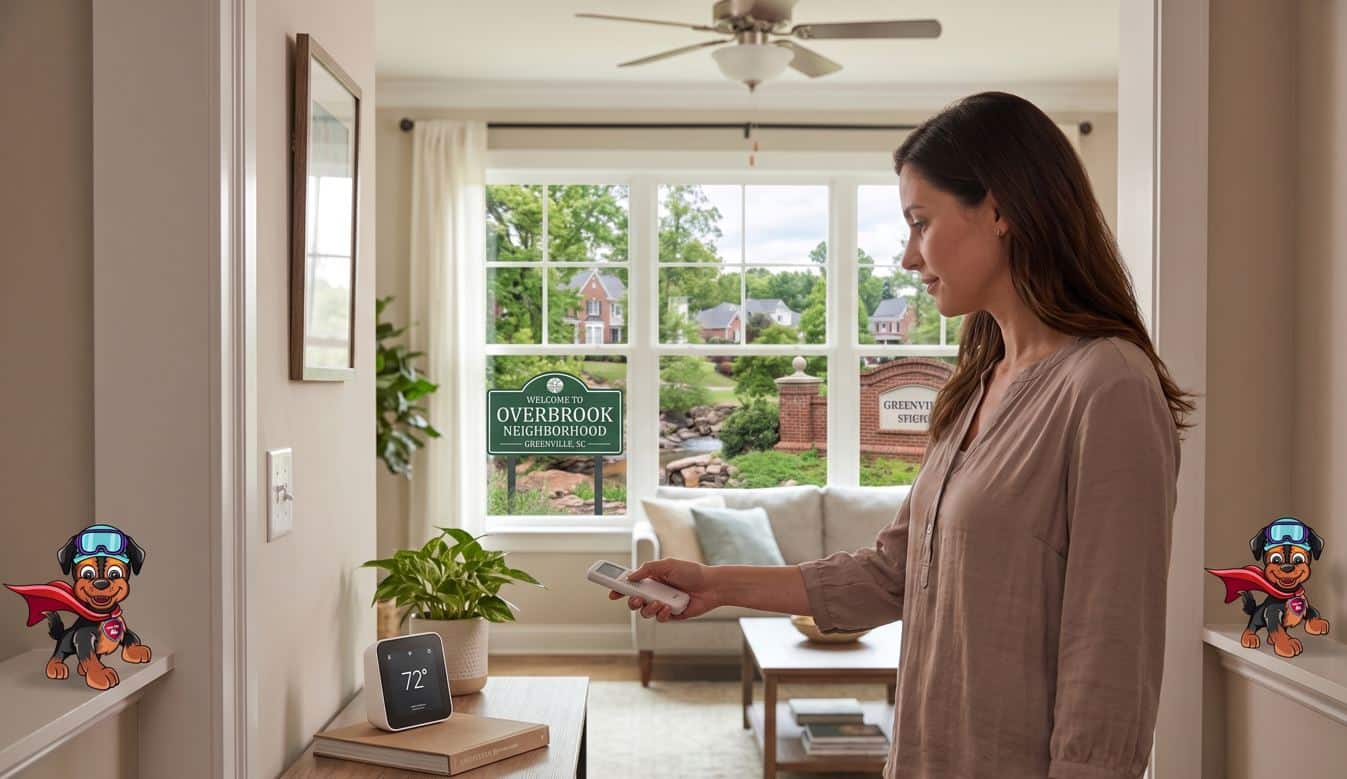
Is 72 Too High for a Thermostat in Summer?
Absolutely not. In fact, for a Greenville area summer, 72°F is an incredibly reasonable, comfortable, and realistic target.
Many homeowners worry that keeping the house at 72°F is working the system too hard. The truth is, your air conditioner is designed to handle a consistent load. If your system is properly sized, well-maintained, and your home has decent insulation, maintaining a steady 72°F during a typical summer day is perfectly fine.
However, comfort isn’t just about the number on the wall. It’s about humidity in our area.
An AC unit doesn’t just cool the air; it removes moisture (latent heat). If your home’s relative humidity is kept below 50%, 72°F will feel like an absolute oasis. If your system is older or oversized, it might cool the house down too fast without removing the moisture, leaving you feeling clammy at 72°F.
Does Having the AC on 72 Instead of 70 Make It Cheaper?
Yes, and the savings are bigger than you think. As a general rule of thumb in the HVAC industry, every single degree you raise your thermostat in the summer can save you roughly 3% to 5% on your cooling costs.
Bumping your thermostat from 70°F up to 72°F might not sound like a massive shift, but it relieves a massive amount of cumulative stress on your system.
-
The Math: If you make that 2-degree adjustment, you’re looking at a 6% to 10% reduction on the cooling portion of your power bill.
-
The Physics: Your air conditioner doesn’t dump colder air into the house when you set it lower; it just runs longer to reach the target. Moving the target from 70°F to 72°F cuts down on the length of your system’s cooling cycles, saving electricity and reducing wear and tear on compressor components.
How Cool Should My House Be If It’s 100 Outside?
This is where we need to talk about a hard rule of physics that most generic online articles completely ignore: The 20-Degree Rule.
Air conditioners are mechanical systems designed to achieve a maximum temperature drop of about 20 degrees between the outdoor air and the indoor air. This is what we call the temperature split.
The Reality Check: If it is a scorching 100°F outside, your residential AC unit is physically doing its absolute best if it keeps your indoor air at 80°F to 82°F.
If it’s 100°F outside and you have your thermostat set to 70°F, your system will run continuously all day long without feeling like it’s cooling.
It won’t hit 70°F, and running non-stop causes components to overheat, evaporators to freeze up, and compressors to fail. When the outdoor temperature hits the triple digits, adjust your expectations and bring your thermostat up closer to 76°F or 78°F to give your system a fighting chance.
The Air Repair AL Expertise
Most blogs will tell you to crank the thermostat up to 85°F when you leave for work. Please, do not do this in Greenville, SC.
Here is what those writers don’t understand about Southern HVAC systems: Sensible Heat vs. Latent Heat.
-
Sensible Heat is the actual temperature of the air.
-
Latent Heat is the moisture (humidity) trapped in the air, your drywall, your furniture, and your carpets.
When you turn your AC up to 85°F all day, your house fills up with thick, humid air. When you get home at 5:00 PM and crank it back down to 72°F, your AC has to work twice as hard. It spends hours pulling gallons of water out of your air and furniture before the actual temperature on the thermostat even drops a single degree.
This causes massive energy spikes and severe system fatigue.
Our recommendation? Use a setup temperature of no more than 4 to 5 degrees higher than your comfort choice when you leave the house. If you like 72°F when you’re home, set it to 76°F or 77°F while you’re away. This keeps the humidity under control so your system can easily recover when you get back.
The Summer Comfort Checklist
To get the most out of your 72°F setting without spiking your power bills, implement these three local pro-tips:
-
Leverage the Wind Chill Effect: Run your ceiling fans counter-clockwise only when you are in the room. Fans cool people, not rooms. They create a wind-chill effect that makes a room feel 4 degrees cooler than it actually is.
-
Keep Your Filter Fresh: A dirty air filter chokes your system’s airflow. When airflow drops, your system can’t hit its 20-degree split efficiently, causing it to run longer and use more power. Change it every 30 to 60 days in the summer.
-
Shade Your Windows: South Carolina sun pouring through west- and south-facing windows introduces massive radiant heat. Close the blinds during the peak hours of 10:00 AM to 4:00 PM to take a heavy load off your AC.
Is your HVAC system struggling to keep up with the summer heat?
Don’t wait for a total system breakdown in the middle of a heatwave. Contact the local pros at Air Repair AL at 864-777-1111 near Greenville today to schedule your summer AC tune-up and keep your home cool all season long! Or contact us online with any questions.