

The Thermostat Myth
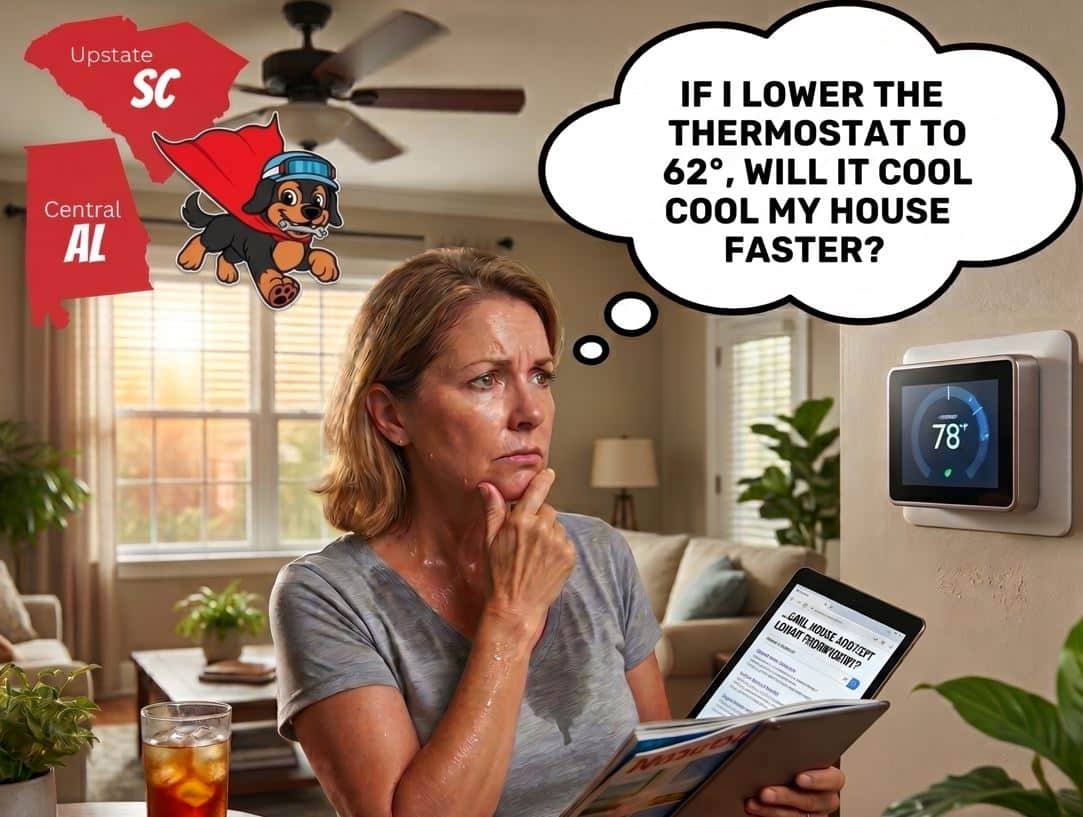
You walk into your home after spending a scorching summer afternoon out at Falls Park in Upstate SC or sweating through a humid day in Central Alabama, and the house feels like a sauna. In a desperate bid for relief, you march over to the thermostat and crank it down to 62°F, hoping the air conditioner will catch the hint and blast a wave of arctic air into the room.
It feels like intuitive common sense: if you want a car to go faster, you step harder on the gas pedal.
But does lowering your thermostat actually make your house cool down faster?
As your local HVAC contractor team at Air Repair AL, we see the aftermath of this myth inside indoor units and on electric bills every single year. Today, we’re busting this myth open with real HVAC science, explaining the actual cost difference between 70°F and 72°F, and giving you professional strategies to actually cool your living space down fast without breaking your system.
1. Does Lowering Your Thermostat Make the House Cool Faster?
The short answer is: No. Absolutely not.
Your home’s air conditioning system is not a gas pedal; it is an On/Off switch.
Whether you set your thermostat to 74°F, 70°F, or an impossible 55°F, your air conditioner expels the exact same amount of cooling energy. It blows air at the exact same velocity and temperature. Typically about 15 to 20 degrees cooler than the air currently entering the return grille.
When you drop the thermostat to 60°F, you aren’t telling the AC to work harder; you are simply telling it to run longer.
The Hidden Trap: Thermal Mass and Static Air Temperature
To understand why your house takes time to cool, you have to look past the air temperature. Air is incredibly easy to cool down. The real enemy is your home’s structural thermal mass.
When your home sits in the sweltering heat, your drywall, hardwood floors, framing studs, and sofas soak up heat like a sponge. When you turn on your AC, the unit rapidly cools the air. However, the moment that cool air hits your hot couch and warm drywall, those solid objects dump their stored heat right back into the room.
Cranking the thermostat lower doesn’t speed up the thermodynamic rate at which sheetrock sheds heat. It just ensures that your system will overshoot your actual comfort zone, run continuously, waste electricity, and potentially freeze your indoor evaporator coil into a solid block of ice.
2. Does Having the AC on 72°F Instead of 70°F Make It Cheaper?
Yes, and the math behind it is staggering.
According to data from the U.S. Department of Energy and real-world grid performance across the Southeast, every single degree you raise your thermostat in the summer can save you up to 3% to 5% on your cooling costs.
Let’s break down the physical reality of why a seemingly minor two-degree shift from 70°F to 72°F leaves more cash in your wallet:
-
Reduced Thermal Infiltration: Heat naturally moves toward cold. The larger the temperature difference between the blazing outdoors and your indoor air, the faster outdoor heat forces its way through your windows, insulation, and doors. Maintaining a 72°F environment slows down this heat infiltration rate compared to a 70°F environment.
-
The Latent Heat Milestone: In humid regions like Greenville, SC and Birmingham, AL, an air conditioner splits its workload into two categories: Sensible Heat (lowering the air temperature) and Latent Heat (wringing moisture out of the air). Squeezing those last two degrees out of a home from 72°F down to 70°F requires the system to run extended cycles primarily to pull out stubborn, deep-set humidity.
By keeping your baseline at 72°F or pushing it to 75°F when you are awake and moving around, you dramatically reduce the workload on your compressor.
3. Is It Cheaper to Run Your AC All Day or Turn It Off and On?
This is the ultimate homeowner question. Is it better to let your AC cruise at a stable temperature all day, or turn it completely off while you’re at work and blast it when you get home?
Mathematically and mechanically, it is significantly cheaper to let your home drift up a few degrees while you’re away, but never turn the system completely off.
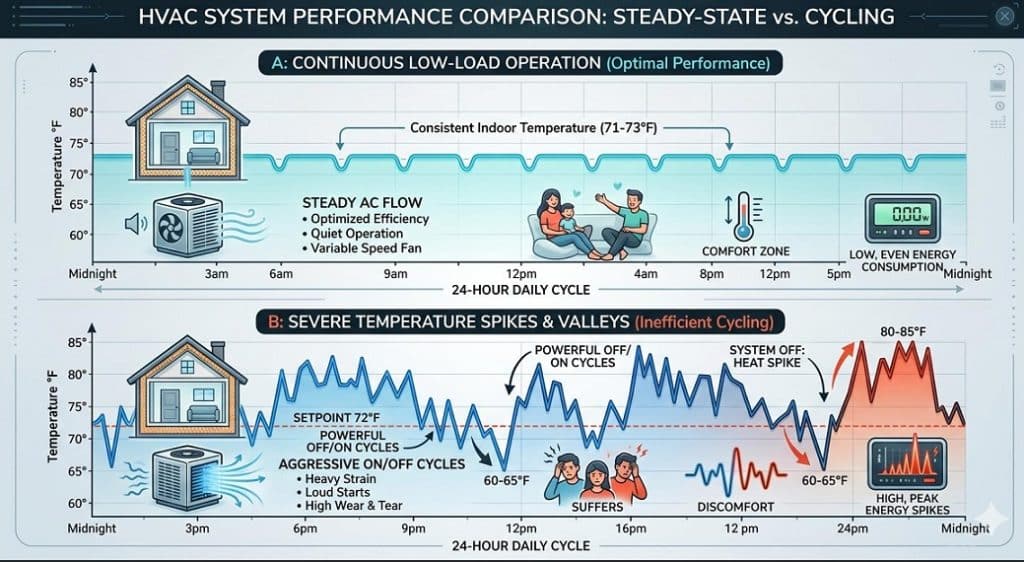
Here is the professional breakdown of why turning the system completely off backfires.
The Mechanical and Electrical Reality
When you turn your AC completely off on a 95°F day, your indoor air temperature can easily spike to 88°F. Worse, your structural thermal mass, the walls and furniture we mentioned earlier, completely saturates with heat.
When you get home and flip the system back on, your AC has to perform a deep recovery run. The system will have to run at maximum capacity for 4 to 6 straight hours just to pull the heat out of your structural belongings.
From an electrical perspective, your compressor suffers the worst penalty during startup. HVAC compressors draw what is known as LRA (Locked Rotor Amps).
It’s a massive spike of electrical current required to break the motor’s inertia and get it spinning. When a system cycles on and off repeatedly to recover from extreme temperature swings, it draws significantly more peak electricity than a system running steady, modulated cycles.
The Air Repair AL Recommendation: Use a programmable or smart thermostat. When you leave for work, set the system to “drift” up to 78°F. This prevents the home from becoming an absolute oven, keeps indoor humidity under control, and ensures a quick, highly efficient recovery down to 72°F when you return.
4. How to Get Your House to Cool Down Faster The Right Way
If lowering the thermostat doesn’t work, what does? If you want to drop the temperature in your home rapidly without destroying your equipment, use these three expert-vetted steps:
Step 1: Maximize Air Velocity and Clear the Returns
Before you touch the thermostat, turn your HVAC fan setting from “AUTO” to “ON.” This keeps the indoor blower motor running continuously, circulating air across the rooms even when the outdoor compressor cycles off. Combine this with ceiling fans running counter-clockwise to create a wind-chill effect on your skin, making the air feel up to 4 degrees cooler instantly.
Pro-Tip: Ensure your return air grilles aren’t blocked by heavy drapes, furniture, or a clogged, dust-caked air filter. Restricted airflow kills heat exchange.
Step 2: Purge the Thermal Load with Targeted Ventilation
If your home has a two-story layout or a particularly hot attic footprint, turn on exhaust fans in your bathrooms and kitchen. These fans help pull hot, buoyant air out of the upper ceilings of your living spaces, forcing your HVAC system to spend less energy battling rising hot air.
Step 3: Manage Solar Heat Gain
Close your blinds, shades, or plantation shutters on the south and west-facing sides of your house. Direct sunlight pouring through standard double-pane glass introduces massive amounts of radiant heat energy that your AC has to mechanically overcome. Blocking the light stops the heat before it enters your home’s thermal cycle.
When Slow Cooling Indicates a Problem
If you’ve set your thermostat correctly, minimized your indoor heat load, and your system still takes hours just to drop the room temperature by a single degree, you aren’t battling a thermostat myth, you’re likely battling a mechanical issue.
Is Your AC Actually Broken?
- Air Blowing Warm/Lukewarm? ───► Check for Refrigerant Leak / Failed Capacitor
- Weak Airflow from Vents? ───► Check for Clogged Filter / Collapsed Flex Duct
- System Running Non-Stop? ───► Check Outdoor Condenser Coil for Dirt & Debris
Out in the field, when our HVAC technicians service homes from the Upstate SC down to Central Alabama, we frequently find that slow cooling is caused by a dirty outdoor condenser coil or low refrigerant charges. When dirt blankets your outdoor unit, it acts like an insulating jacket, preventing the system from releasing indoor heat outside.
Need a Little Help?
Don’t force your system to suffer through an inefficient summer. If your air conditioner isn’t keeping up with the heat, give the team at Air Repair AL a call at 864-777-1111 in Upstate SC and 659-777-1111 in Alabama. Or contact us online with any questions.
Our licensed, pet-friendly technicians will run a comprehensive diagnostic on your system, clear away the hidden efficiency killers, and keep your home genuinely cool all season long!
More Thermostat Tips
Common Thermostat Error Codes Explained for Greenville Homeowners