

What Greenville Area Homeowners Should Check First
When your thermostat stops working, it’s rarely just “the thermostat.”
It’s usually part of a bigger conversation between your home, your heating and cooling system, and your power supply. Somewhere along the way, that conversation breaks down between the two.
If you’re in Greenville or the surrounding Upstate area, this can happen more often than you’d think thanks to:
-
Heat pump systems (very common here)
-
Summer humidity
-
Occasional power flickers and storms
-
Older homes mixed with newer smart technology
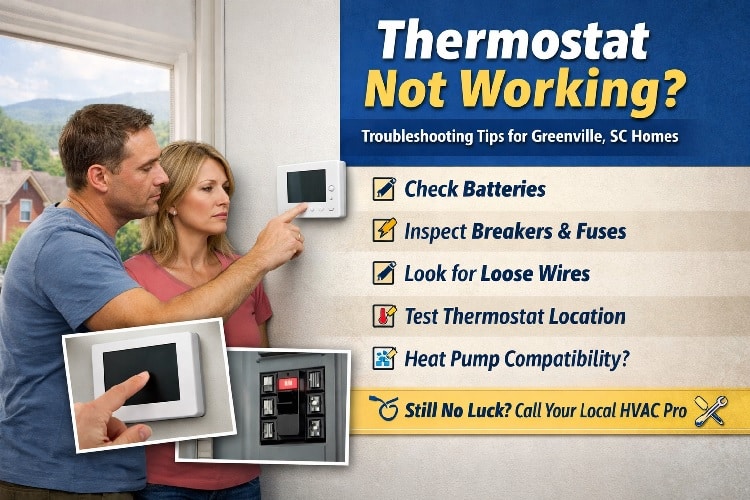
Let’s walk through why thermostats stop working, what you can safely check yourself, and when it’s time to bring in an HVAC professional.
First Things First: What Does “Not Working” Actually Mean?
Homeowners often search “thermostat not working” but that can mean very different things.
Here are the most common scenarios we see in Greenville homes:
-
The thermostat screen is blank
-
The screen is on, but nothing happens
-
The HVAC system won’t turn on or won’t shut off
-
The temperature feels wrong compared to the setting
-
A smart thermostat keeps disconnecting from Wi-Fi
-
The system works sometimes, then stops
Each of these points to a different root cause, which is why generic “reset it” advice often falls short.
Reason #1: Power Issues (The Most Common Culprit)
A thermostat can’t control anything without power.
What could be happening:
-
Dead batteries (even hardwired thermostats often use them as backup)
-
A tripped breaker
-
A blown HVAC fuse
-
Low-voltage power loss from the air handler or furnace
Why this matters in Greenville:
Storms and brief power interruptions are common in the Upstate. Even a quick flicker can knock out a thermostat or trip a safety switch inside your HVAC system.
What to check:
-
Replace the batteries (even if the screen is still on)
-
Check your breaker panel
-
Look for a tripped float switch near your indoor unit (common when drain lines clog in humid climates)
If the screen stays blank after this, the issue may be deeper than the thermostat itself.
Reason #2: Your Thermostat and HVAC System Aren’t “Speaking the Same Language”
Not all thermostats work with all systems.
This is especially important in Greenville homes with heat pumps, which require different wiring and control logic than standard furnaces.
Common compatibility problems:
-
A thermostat installed for gas heat controlling a heat pump
-
Missing or miswired reversing valve (O/B wire)
-
Smart thermostats installed without a common wire (C-wire)
Why competitors miss this:
Most blogs list “bad thermostat” without explaining why it’s bad. In reality, the thermostat may be fine. It’s just mismatched.
If your system blows cool air in heating mode or runs constantly, this is a strong clue.
Reason #3: Sensor Problems (The Temperature Isn’t Being Read Correctly)
Your thermostat relies on internal sensors to measure room temperature.
Problems we see often:
-
Thermostat installed in direct sunlight
-
Mounted near kitchens or bathrooms
-
Placed above supply vents
-
Sensors failing due to age or humidity exposure
The result:
Your home feels uncomfortable even though the thermostat thinks it’s doing the right thing.
This is one of the biggest reasons homeowners say:
“My thermostat says one thing, but it feels completely different.”
Reason #4: Wiring Issues (Especially in Older Greenville Homes)
Behind the thermostat is low-voltage wiring that connects it to your HVAC system.
Issues that cause failure:
-
Loose connections
-
Corroded wires from humidity
-
DIY installations gone wrong
-
Chewed wires (yes, it happens)
Older homes around Greenville often have:
-
Spliced wiring
-
Mixed HVAC upgrades over time
-
Older control boards not designed for modern thermostats
A loose wire can cause intermittent issues. Working one day, failing the next.
Reason #5: Smart Thermostat Problems Aren’t Always “Smart”
Smart thermostats add convenience but also complexity.
Common smart thermostat complaints:
-
Loses Wi-Fi connection
-
App works but system doesn’t respond
-
Short cycling
-
Random temperature changes
What’s really happening:
-
Wi-Fi issues are often mistaken for HVAC failures
-
Power-sharing problems without a C-wire
-
Software updates that reset schedules
This is where many online guides stop short. The thermostat isn’t broken, it’s struggling to stay powered or communicate properly.
Reason #6: The Thermostat Is Fine—Your HVAC System Is Not
This is the hardest truth for homeowners to hear.
If your thermostat is calling for heating or cooling, but nothing happens, the issue may be:
-
A safety switch shutting the system down
-
A control board issue
-
A clogged condensate drain (very common in summer)
The thermostat is just the messenger.
When Should You Call an HVAC Professional?
You should stop troubleshooting and call for help if:
-
The thermostat has power, but the system won’t respond
-
You’ve replaced batteries and checked breakers
-
The system turns on but shuts off quickly
-
You have a heat pump that isn’t heating correctly
-
You smell burning or notice buzzing sounds
At this point, continuing to guess can cause more damage or leave your home uncomfortable longer than necessary.
Can a Thermostat Be Repaired? Or Does It Need Replacement?
Sometimes yes. Sometimes no.
Repair or adjustment makes sense when:
-
Wiring is loose
-
Sensors are misreading
-
Settings are incorrect
-
Compatibility issues can be corrected
Replacement is smarter when:
-
The thermostat is outdated
-
It lacks heat pump compatibility
-
Smart features aren’t supported by your system
-
Internal components have failed
A professional can test this quickly instead of guessing.
Why This Matters More Than You Think
A thermostat isn’t just a wall control. Iit’s the command center for your comfort, energy use, and system longevity.
When it’s not working correctly:
-
Your energy bills rise
-
Your HVAC system works harder than it should
-
Comfort becomes unpredictable
That’s why understanding why it’s failing, not just resetting it is key.
Final Thought for Greenville Homeowners
If your thermostat isn’t working, don’t assume the worst but don’t ignore it either.
Start with the basics. Pay attention to how your system responds. And if things don’t add up, having a local HVAC expert who understands Greenville homes, heat pumps, humidity, and power issues can save you time, money, and frustration.
Still not sure what’s causing the problem?
If your thermostat has power but your heating or cooling still isn’t responding, it’s time for a professional diagnosis. Our local Greenville HVAC technicians can quickly pinpoint whether the issue is the thermostat, wiring, or the system itself. No guessing, no pressure.
Call Air Repair AL in Greenville at 864-777-1111 for a free check or contact us online with any questions.